
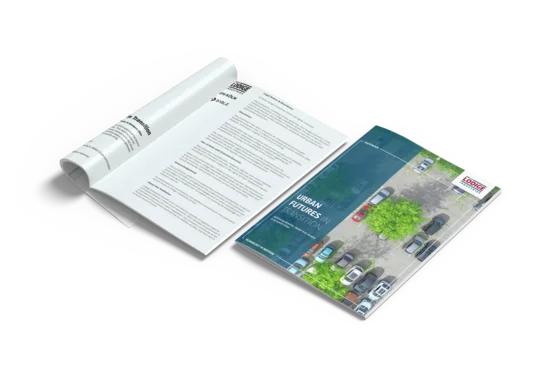
Urban Futures in Transition
Rethinking Mobility, Space and Access in European Cities
European cities are not running out of ideas. They are running out of space.
Housing, mobility, climate adaptation, logistics and economic growth are all competing for the same finite urban resource. As cities continue to densify, the defining challenge is no longer which technologies to adopt, but how limited space can be allocated more intelligently.
Ready to rethink urban space?
Be among the first to explore the ideas, research and practical strategies shaping the future of European cities.
Why this whitepaper matters
The future of urban development will not be shaped by innovation alone. It will be shaped by how intelligently we use space.
Urban transformation has entered a new phase. Space is no longer a given. It is the critical constraint behind housing, mobility, climate adaptation, infrastructure and quality of life.
This whitepaper brings together European research, a representative survey conducted by IFH KÖLN, expert interviews and real-world case studies to explore how cities are responding to growing spatial pressure.
It also shows why parking is no longer just a technical function, but an important strategic lever for managing urban space.
Key findings
Representative survey, IFH Cologne 2026 (n = 1,056)
What you'll discover
- Why space, not technology, has become the defining variable of urban development
- How housing, climate adaptation, logistics, electrification and mobility are increasing pressure on limited urban space
- What citizens really expect from accessible and liveable city centres
- How European cities such as Amsterdam, Rotterdam, Utrecht, Freiburg and Bruges are navigating spatial conflict
- How real projects in Amsterdam, Aarhus, Rotterdam, Düsseldorf and London demonstrate space-efficient infrastructure in practice
- Six strategic principles for managing mobility in space-constrained cities
- A practical reflection tool to evaluate the role of parking in your city or project
Built on research, practice and European perspectives
This publication combines:
Research
Current European studies and structural analysis on urban space, mobility and land use.
Behavioural insights
A representative 2026 survey by IFH KÖLN on accessibility, parking and public acceptance.
Expert voices
Perspectives from urban practitioners in Amsterdam, Rotterdam, Utrecht, Freiburg and Bruges
Real-world examples
Case studies showing how space-efficient solutions are already being implemented in complex urban environments.
Ready to rethink urban space?
Be among the first to explore the ideas, research and practical strategies shaping the future of European cities.
Complete the form below to receive your complimentary copy of Urban Futures in Transition. Your data will be handled confidentially and will not be shared with third parties.
Request the full Whitepaper here
A publication by Lödige Industries in collaboration with IFH KÖLN and BABLE Smart Cities.